
A bank overseas asks for your company’s incorporation documents. A foreign registry requests a power of attorney. A business partner needs proof that your entity is in good standing. Along with the document, the recipient may ask for an apostille, authentication, or legalization.
This guide focuses on U.S. origin business and corporate documents used abroad and walks through seven steps to help you identify and complete the applicable requirements. For documents issued outside the United States, see our guide to non-U.S. document authentication and legalization.
Key Takeaways
- Two questions set the path: who signed the document, and whether the Apostille Convention applies between the United States and the destination.
- As of October 2026, the Convention has 130 Contracting Parties. Recent additions, including China and Canada, have replaced embassy legalization with apostilles for covered documents where the Convention applies (HCCH status table, Apostille Convention).
- For countries outside the Convention, the embassy or consulate sets the final requirements, and that step is often the least predictable.
Find the step you need:
1. Recipient requirements · 2. Apostille or legalization · 3. Document and signature · 4. Preparation · 5. Certification · 6. Legalization · 7. Final check and delivery
Key Apostille and Document Legalization Terms
| Term | What it means |
|---|---|
| Notarization | A notary performs a legally authorized act, such as taking an acknowledgment of a signature or administering an oath. The act required depends on the document and the applicable rules. |
| Notarial certificate | The statement the notary completes, signs, and seals to record the act performed, such as an acknowledgment or a jurat. |
| Competent authority | The office designated to issue apostilles. For state and local documents, usually the secretary of state. For federal agency documents, the U.S. Department of State Office of Authentications. For federal court documents, the court’s clerk. |
| Authentication | Certification of an official’s signature or seal. When a document requires legalization, authentication certificates may be needed at the state and federal levels. |
| Apostille | A certificate issued by a competent authority that authenticates a public document’s origin where the Apostille Convention applies. It replaces embassy or consular legalization for that use. |
| Legalization | Certification by the destination country’s embassy or consulate, completing the authentication chain. Some jurisdictions call related steps attestation. |
An apostille authenticates the official’s signature, the official’s capacity and, where applicable, the seal or stamp. It does not validate the document’s contents. The document’s wording, the signer’s corporate authority, translation, and intended use are separate requirements. For a fuller glossary, see Document Authentication and Legalization: Common Terms.
The Document Authentication Process at a Glance
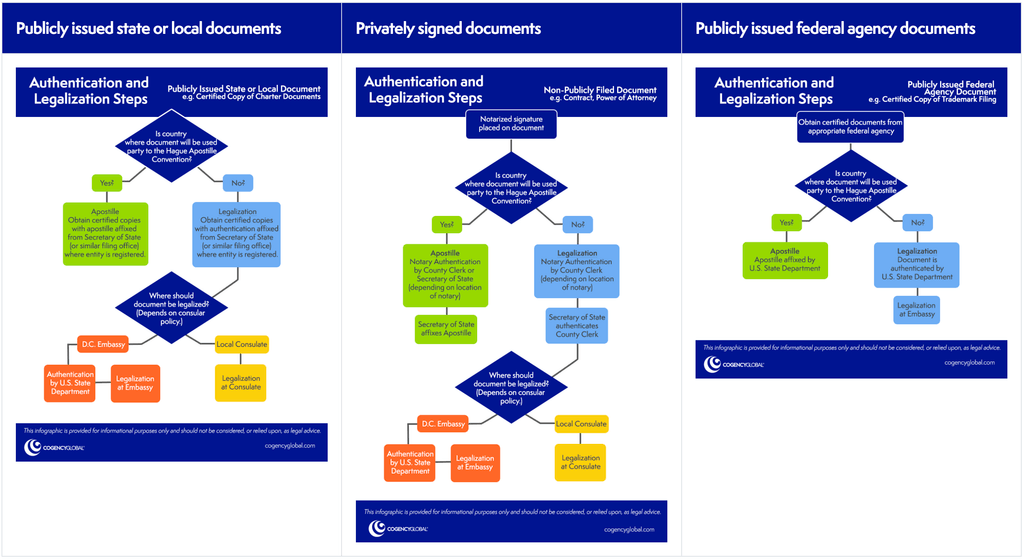
Each flowchart follows one type of document through the full authentication chain, from the official or notary who signed it to the embassy or consulate. Where the Apostille Convention applies, an apostille from the competent authority completes the certification and the later steps fall away.
Step 1: Confirm Recipient Requirements for U.S. Documents
Every request starts with the organization that asked for the document, such as a bank, registry, court or business partner. Its written instructions define what a finished package looks like. Before anything is ordered or signed, these details need to be confirmed:
- The destination country or territory, the intended use, and the exact document required.
- Whether the recipient needs an original, an officially certified copy, or another specified format.
- How recently the document must have been issued.
- Required signatures, witnesses, translations, and number of copies.
- The deadline and whether the package must be received or accepted by that date.
For example, a foreign bank may ask for a recently issued certificate of good standing. A copy already in the company’s files may not qualify, even if it was properly certified at the time. For certificates of good standing and certified copies of charter documents, confirm the issuing state’s requirements before ordering. Some states require the apostille or authentication to be requested when the certificate is issued.
Pro tip. Under the Apostille Convention, an apostille does not expire, but the recipient may still require a recently issued underlying record.
Step 2: Determine Whether You Need an Apostille or Legalization
The Hague Apostille Convention simplifies authentication of covered public documents between countries where it applies. A request generally follows one of two paths:
| If | Then |
|---|---|
| The Convention applies to the document and the country pair | An apostille from the appropriate competent authority. No embassy or consular legalization is needed. |
| The Convention does not apply and certification is required | The authentication chain, ending with the destination’s embassy or consulate. |
The Convention has 130 Contracting Parties as of October 2026. Check the effective date and any objections affecting its application between the United States and the destination.
The Convention is scheduled to enter into force for Thailand on February 28, 2027. Until then, documents bound for Thailand still follow the legalization path.
Cogency Global provides a list of Convention parties for reference. Confirm the destination country’s current Convention status, the applicable effective date, and any objections affecting its relationship with the United States by reviewing the HCCH status table before submitting documents.
Step 3: Identify the Correct Document Authentication Authority
Who issued the document, and whose signature or certification appears on it, decides where it must go. Common business documents fall into three groups:
| Document group | Examples | What needs to be established |
|---|---|---|
| Official state or local records | Certified incorporation records, certificates of good standing, state court records, vital records | Which office must issue or certify the record, and which authority can authenticate its official’s signature |
| Company-prepared or privately signed documents | Board resolutions, powers of attorney, corporate secretary certificates | Who must sign, which notarial act or other certification is required, and which authority can certify that signature |
| Federal documents | USPTO certified copies, federal agency certificates | The issuing agency’s or court’s requirements, and the applicable federal authority |
Federal court records are a separate case. Clerks and deputy clerks of U.S. federal courts issue apostilles on their own courts’ documents. Other federal documents go to the U.S. Department of State.
Step 4: Prepare Documents for Apostille or Authentication
Certifying authorities act only on documents in the form they require. A registry search result, an ordinary photocopy or a downloaded image does not substitute for an officially certified copy.
- Official records. Certified copies are ordered from the issuing office, in the form the certifying authority and the recipient require.
- Privately signed documents. Before signing, confirm who has authority to sign, whether a witness is needed, and which notarial act applies. The notary’s certificate must be complete and match that act. The apostille comes from the state where the notary is commissioned.
- County steps. Some states require county certification of a notary first. New York, for example, requires county clerk certification of notarized documents before submission to the state.
- Federal originals. The U.S. Department of State warns against notarizing an original federal document; once notarized, it is no longer valid for this process.
- Translations. Which documents need translation, what translator qualifications the recipient requires, and when the translation must be complete are settled at this step.
Apostilles for Remotely Notarized Documents
Remote online notarization (RON) lets a signer appear before a notary by video. It can save time on private documents, but acceptance turns on two separate checks: the authority that will issue the apostille, and the recipient abroad.
Rules vary by state. The Texas Secretary of State, for example, will apostille online notarized documents when the submission includes the notary’s ledger entry for the session and a notarial certificate stating the notarization was performed by two-way audio and video communication. Texas also cautions that some countries do not accept online notarized documents, even with a valid Texas apostille. Remote notarization also does not mean an electronic apostille: Texas does not issue e-Apostilles, so the result is a paper apostille attached to the document and returned by mail or pick up.
Step 5: Obtain an Apostille or Authentication Certificate
State and local records, and documents notarized in a state, go to that state’s competent authority, usually the secretary of state. Federal agency documents go to the U.S. Department of State Office of Authentications, and federal court records to the issuing court’s clerk.
If an apostille completes the covered use, the request moves to Step 7. If the destination requires legalization, it continues to Step 6.
Electronic Apostilles and Universal Apostille Certificates
These formats affect how the certificate is issued and used:
- An electronic apostille (e-Apostille) is the same certificate, issued as a digitally signed file instead of on paper.
- A universal apostille is one certificate format for every destination, instead of separate apostille and authentication certificates.
Confirm the available format with the issuing authority and the recipient’s document submission requirements before ordering.
Electronic apostilles. These are not new: the Hague Conference launched its electronic apostille program in 2006. The adoption has been slow because the receiving party abroad decides whether it will accept a digital file. As Utah’s authentication office puts it, foreign agencies “retain the authority to determine whether they accept digital files.” Paper apostilles are still widely used.
| For an e-Apostille to be usable | What can cause rejection or invalidation |
|---|---|
| The issuing state offers e-Apostilles for that document type. Several exclude vital records. | The recipient does not accept electronic public documents. |
| The online notary is commissioned in the state issuing the e-Apostille, not just any state. Kentucky, for example, accepts only documents notarized by a Kentucky online notary. | Printing it. E-Apostilles issued in Connecticut are not valid if printed. |
| The recipient confirms in advance that it accepts the digital file. | Missing required signatures or an incomplete notarial certificate, the same as on paper. |
| The recipient can verify it through the issuing state’s online register. |
Universal apostilles. Several states, including Texas and Kentucky, now issue one certificate for every destination. It serves as an apostille for Convention countries and as an authentication certificate for the rest. It is one format, not one step: countries outside the Convention still require embassy or consular legalization and usually, the U.S. Department of State and the embassy, as described in Step 6.
Step 6: Complete Embassy or Consular Legalization
For a destination outside the Convention, the document moves through a chain in which each link certifies the one before it:
1. State authentication. The state’s competent authority issues an authentication certificate or a universal certificate that serves that purpose. Federal documents skip this step.
2. U.S. Department of State authentication. The Office of Authentications authenticates the state or federal official’s signature. Embassies in Washington D.C. requires it. Some consulate legalize state authenticated documents without it, depending on the consular policy.
3. Embassy or consular legalization. The destination country’s embassy in Washington, D.C., or one of its consulates elsewhere in the United States, completes the chain.
Embassy or consulate? Both can legalize documents. The embassy is the country’s diplomatic mission in the capital; consulates are its offices in other cities. Each office serves an assigned group of states, called its consular district, and the country decides which office handles a document, often based on where the document was issued or where the requester lives. Thailand’s consulate in New York, for example, handles legalization for 10 northeastern states. A consulate is not an open alternative to the embassy: the right office is the one whose district covers the document.
Each country sets its own legalization rules: the required sequence, supporting forms or identification, whether submissions must go through an authorized provider, and whether further attestation is needed after the document arrives. Trade documents such as commercial invoices and certificates of origin often follow their own procedures.
Pro tip. Embassy and consular officers may review a document’s content as well as its signatures. Confirm any content restrictions before submission, as a refusal may require revised documents and renewed certifications.
Step 7: Review and Deliver the Authenticated Documents
Before release, the completed package should be checked against the recipient’s written instructions:
- The correct document, entity names, and number of copies.
- All required certificates and attachments, present and intact.
- An underlying record that meets the recipient’s issue date requirement.
- Complete translations and supporting materials.
- A delivery format that matches what the recipient requires.
Paper certificate attachments stay intact, and electronic files are preserved with their digital signatures. A recipient that wants to confirm an apostille can check it with the issuing authority, and many authorities now offer online registers for this.
Certification, delivery, and acceptance are separate milestones. A request is not complete until all three are confirmed.
Common Reasons Apostille and Legalization Requests Are Rejected
Many rejections trace back to a handful of avoidable errors, and each one can mean starting the chain over:
- Wrong path. An apostille sent to a country that requires legalization, or a full legalization chain for a country that now accepts apostilles.
- Wrong authority. A federal document sent to a state office, or a state document sent to the Department of State for an apostille.
- An incomplete or wrong notarial certificate. A missing seal, signature or date, or wording that does not match the act performed, stops the apostille.
- A copy that is not certified. Photocopies and printouts generally do not meet certification requirements.
- An out-of-date document. Recipients and some authorities set age limits on certified records. Texas, for example, requires recordable public records submitted for apostille to be less than five years old. See Age of Documents for US State-Level Authentication and Legalization.
- Translation gaps. A destination may require a qualified translation, itself notarized and authenticated.
- Embassy specific requirements. Missing forms, missing supporting documents, or content the mission will not accept.
Support for Document Authentication and Legalization
Legalization and authentication can involve several offices, each with its own rules. Confirm the required sequence for document retrieval, certification, and legalization based on the document type and destination before submitting your request.
- Scope and path. We start from the recipient’s written instructions and confirm the destination’s current Convention status, any objections, and the recipient’s format requirements.
- Document retrieval. We obtain certified copies and certificates of good standing from the issuing states, and certified documents from many federal agencies.
- State, federal and embassy submissions. Our Authentication, Legalization and Apostille Services team works directly with state offices, the U.S. Department of State, and embassies and consulates, and responds to their supplemental requests.
- Multi-jurisdiction coordination. Documents from several states, or a mix of state, private, and federal records, move as one coordinated request.
- Final check and follow-through. We review the completed package against the recipient’s instructions before release and track each request through delivery.
Confirming requirements early and allowing time for each certification step can help reduce delays and keep your documents on track for use abroad.
This article provides general information and is not legal advice. Requirements change and vary by jurisdiction, document type and destination. Confirm current requirements with the relevant authorities or a qualified advisor before submitting documents.
Leave Us A Comment
Did you find this article useful? We'd love to hear your thoughts. Join the conversation by leaving a comment or question below.



Hello I work for Zest HoldCo Inc incorporated in Delware with entities in the UAE and Cayman. We need support with our Delaware C-Corp, which we have established a few months back. We are in need of certifying / legalizing ZE HoldCo’s (Delaware incorporated) incorporation documents in the US and then furthermore having them notarized by the UAE embassy in the US. Is this a service that you would be able to provide? We need this to use in the UAE for other corporate matters. Documents we would need to certify / notarize include: Certificate of Incorporation Document showing authorization signatories Thank you, Noman
Thank you for getting in touch with us. We will reach out to you shortly.
Thank you for providing such a clear and detailed guide on document authentication and legalization! The step-by-step breakdown really simplifies what can be a confusing process, especially for those dealing with international requirements for the first time.
Thanks so much for reading and we’re glad you enjoyed the article!
Thank you for this incredibly detailed and insightful guide on document authentication and legalization! The step-by-step breakdown really helps clarify what can often be a complex process.
Thanks so much for reading! We’re glad you found it useful.